

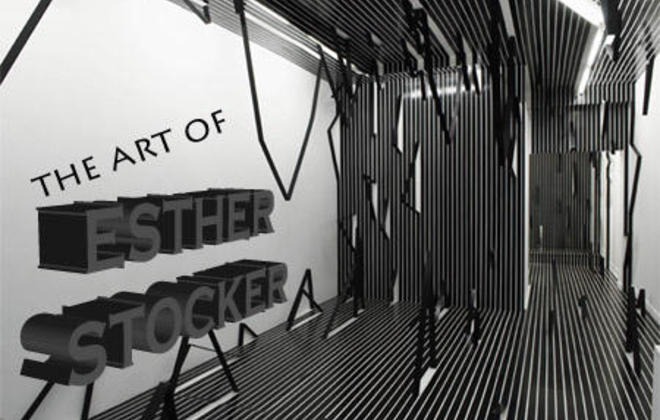
ESTHER STOCKER
 Share on Facebook
 Share on Twitter
 Subscribe
 Comments
ESTHER STOCKER
How extensive is your lack of knowledge about space?
It is really hard to describe, but I never really know where one thing is at... like myself for instance. How to describe where one is? You could describe the things around you, if they could define your position. But then I have to define their position.
Imagine I am on a chair. The chair is two metres from a wall. The wall is on the second floor of a house in Vienna and so on. But what relates to what? Even the solar system is dependant on being described by some unclear idea of a universe being described by a confused human observer. That’s why it seems so unclear to me. Why should I trust a chair to tell me where I am? It seems highly absurd when you start to think about it.
It is the close relationship to the observer that makes the concept of space so unclear to me. I cannot describe any position. So I want to admit that there is more than one thing that I don’t know about space. I don’t know my position and that is why I don’t clearly know the position of other things too.
Your work seems to say something profound about space, despite and perhaps because of your ignorance of its nature.
It is ironic, as the 'fact' of space somehow enters the work unasked. All I ever wanted to know is how a relation functions. What one thing is doing next to another, why we can differentiate things or why we want to differentiate things. Even if we cannot describe the point where one thing becomes another, we seem to somehow know that it happens. That fascinates me.
Is there a certain intuitive understanding in these fuzzy, imprecise areas of your/our knowledge?
Decisions, even the most minimal formal decisions, have a consequence in space. Somehow they describe an exact position somewhere. The somewhere is space. I am completely convinced that fuzziness is logical. It is something unstable to hold on too. It’s paradoxical that we can rely on something so imprecise.
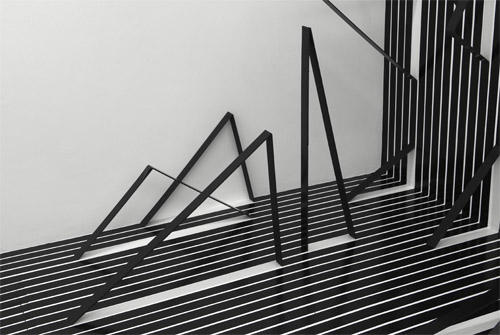
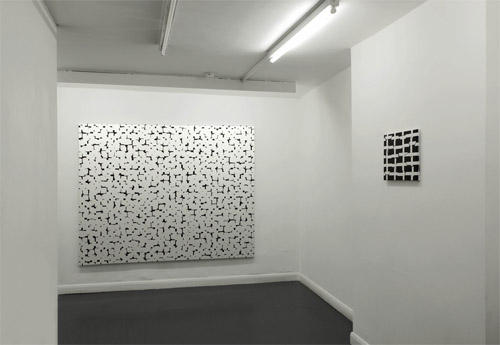
Is the heavy use of black in both your installation and your paintings a reference to this unknown?
It is the highest differentiation that I can build up in a relation - something you can easily distinguish on a formal level; something that at first sight seems like a clear thing to distinguish, where you immediately know what one thing is compared to the other. The fuzziness is still there, just lying within how the things are positioned or what they do. If they slightly disappoint your expectations, you might loose your orientation. It is about doubting our sense of control.
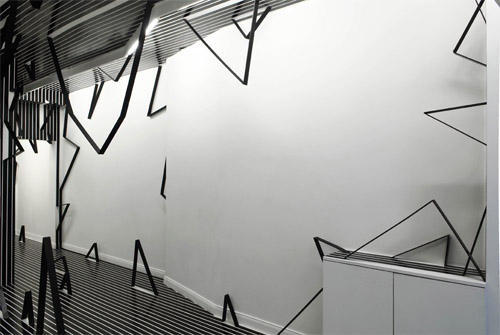
Can you tell us what the physical ingredients of this instillation are? Gaffertape? Any sticky-back plastic?
Ordinary gaffertape from the hardwarestore next door and some black cardboard for the reinforced parts.
This is the Science issue of our magazine, which works well because there seems to be a lot of references to scientific imagery (graphs/grids/static) in this work. How can art draw inspiration from science?
The first science text I have ever been excited about was Perception of Texture by Bela Julesz. He beautifully describes the limitations of our perceptive apparatus - how cognitive processes support low level perception and how the recognition of the continuity of complex patterns is limited by the gradual overload of the perceptive apparatus.
I owe a lot to science. I really enjoy following the research of human perception and cognition, and I am fascinated by the aesthetic elegance of some scientific research, as well as the importance that images play for some science, as evidence for a theory.
And after reading some scientific theory I usually end up with something precious - with a better knowledge of the limitations of our human understanding.
More on Museum 52 here.
 Except where otherwise noted, contents of this article are licensed under the Creative Commons Attribution-Noncommercial-No Derivative Works 3.0 Unported License
Don't Panic attempt to credit photographers and content owners wherever possible, however due to the sheer size and nature of the internet this is sometimes impractical or impossible. If you see any images on our site which you believe belong to yourself or another and we have incorrectly used it please let us know at panic@dontpaniconline.com and we will respond asap.
MORE FROM DON'T PANIC









Comments