

AKIRA KUROSAWA
 Share on Facebook
 Share on Twitter
 Subscribe
 Comments
AKIRA KUROSAWA
31 Monday 31st May 2010
The films of Akira Kurosawa are like a crash-course in the history of cinema. Emerging at the dwindling of Hollywood’s Golden Age, Kurosawa plucked ideas from ancient traditions and modern Westerns to go on to later inspire every spaghetti Western and action movie ever made afterwards.
The BFI is to release The Kurosawa Samurai Collection on 7 June, a five-disc box set including Seven Samurai, Throne of Blood, The Hidden Fortress, Yojimbo and Sanjuro.
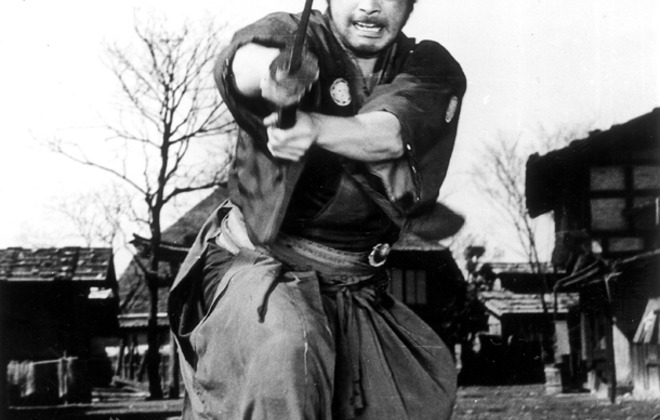
Made following Kurosawa’s rise to auteur-status with the films Rashomon and Ikiru, each of these five films stars the legendary Toshiro Mifune in the lead role and each is a breathtaking masterpiece. Watching them together reveals the narrative behind Kurosawa’s evolving themes and ideas, as well as the mainstream’s appreciation of them.
Throne of Blood, released in 1957, is Kurosawa’s adaptation of Shakespeare’s Macbeth. The scale and production values alone indicate his studio’s willingness to agree to the concessions of Japan’s most famous director. Perhaps only after having directed his numerous flawless Japanese period pieces could Kurosawa have successfully combined Shakespeare’s themes of power and corruption with the samurai traditions of honor and loyalty.

With another hit on his hands, Kurosawa was elevated to a level of international stardom. The Hidden Fortress in 1958 was a more lighthearted action/adventure drama, featuring two peasants consumed with greed and the all-powerful general who playfully manipulates them at every turn. Mifune’s iconic character is more noble here and overstated than in some of Kurosawa’s earlier work, and he’s consequently given a remarkable one-on-one fight scene as beautifully choreographed as anything Kurosawa’s done.
Amazingly, the film proved to be an inspiration for George Lucas’s Star Wars, as he borrowed the concept of the fugitive Princess Yuki to model Princess Leia.
This makes sense however, as the strong individuals portrayed in The Hidden Fortress, Yojimbo and Sanjuro embodied more Western or American values. Japanese heroes had always been modeled on the basis of a team or group, and Kurosawa slowly changed that with his own admiration for John Ford’s Westerns.
Mifune’s Sanjuro in the 1961 film Yojimbo is as much a lone gunslinger as John Wayne. At the beginning of the film, he picks up a stick and tosses it in the air to point him in the direction of a town. Like Shane wandering onto the ranch, Sanjuro randomly knocks on doors in this town controlled by warring gangs and takes up the cause of the town’s protection.
Soon after, Sergio Leone made an almost direct remake starring Clint Eastwood in A Fistful of Dollars, and the Sanjuro character’s popularity lead Kurosawa to make a comedy with Mifune in virtually the same role. It broke down the samurai genre and its own conventions with scenes that are oddly similar to Yojimbo. If Sanjuro works as an almost perfect parody of the ideal Western hero, it makes sense why it would.

But the most notably influential film in the collection is Seven Samurai, which is also the earliest of the bunch. Watching it in comparison with the others reveals the same style and approach to making the genre come alive, but we are presented not with noble heroes in Seven Samurai but frail men. The film is one of humanity, not of heroics or violence, and there are deep moments of empathy and pain we feel toward the characters. The action, while propulsive and helping to lead the camera’s movements, is highly chaotic and unclear, all of which is designed to add to the tragedy that is the film and the samurai.
Seven Samurai was the first film to feature a group of warriors or heroes, each with their own personalities, going on a mission with a common goal. We can see their replication in any number of genres and films, including the American remake of the film The Magnificent Seven.
Remove these five films from the history of cinema and there is no longer much of a history to speak of.
Answer the question below and submit your answer to william@dontpaniconline.com for your chance to win a pair of tickets to the film screening of your choice to BFI Southbank's month-long feature of Kurosawa & His Influence. Look at the full schedule here.
Which Kurosawa film inspired Sergio Leone's The Man With No Name Trilogy?
Don't Panic attempt to credit photographers and content owners wherever possible, however due to the sheer size and nature of the internet this is sometimes impractical or impossible. If you see any images on our site which you believe belong to yourself or another and we have incorrectly used it please let us know at panic@dontpaniconline.com and we will respond asap.
MORE FROM DON'T PANIC














Comments