

SEPARADO!

 Share on Facebook
 Share on Twitter
 Subscribe
 Comments
SEPARADO!
16 Monday 16th August 2010
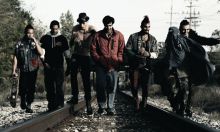
The best way to describe Seperado!, the debut offering from Welsh legend Gruff Rhys of Super Furry Animals and Neon Neon fame is something along the lines of a psychedelic mock rockumentary and an odyssey to a mythical parallel universe. Directed by Dylan Goch, it shows Rhys embark on a journey to the Welsh-speaking, South American region of Patagonia, in search of his long-lost uncle, musician Rene Griffiths. Griffiths, whose Welsh-Latin-gaucho style has captivated Rhys from a young age serves as the main motivation for the tour, but as the film progresses it becomes more about exploring the concept of family and Rhys’ own personal journey.
The story of Rhys’ Welsh heritage is complex and involves death, persecution and migration to the other side of the world. That said, the film is not a history lesson – Gruff fully embraces Patagonian culture as he mixes with locals, performing in the theatres, nightclubs and desert teahouses of Wales, Brazil and the Argentine Andes, whilst meeting Patagonian relatives along the way. Rhys seems to have unknowingly created a film focusing on Welsh pride owing to the extensive use of the Welsh language throughout the film. In essence, it is a tour documentary with interjections of fantasy, which when accompanied by the excellent soundtrack give it a distinctly mythical feel that reflects the mythical nature of Patagonia. It is worth noting that Rhys’ musical collaboration with Brazilian protest singer, Tony De Gattora is something to watch out for – Rhys’ excitement about the De Gattora is definitely infectious. If you are a fan of irreverent humour and do not mind Welsh subtitles then you will definitely enjoy Seperado! I think it will satisfy die-hard Super Furry Animals fans but will win Rhys legions of new recruits as well. Don’t Panic talks to Gruff at the first screening of Seperado! at the British Film Institute.
What was the main reason behind making Seperado!?
Well I sort of came up with this story in my head…you know? And watching Rene Griffiths on TV – I became pretty obsessed by stories of Patagonia.
Did you learn a lot about Patagonia in school?
I discovered a lot on Welsh language telly. It’s painted to be this land of milk and honey, this amazing place where everybody speaks Welsh. When it occurred I just accepted it. Now I think, ‘Is that really true?’ I wanted to arrange a tour to check it out and met some Patagonian family that had come back to Wales as tourists – they set up gigs for me in schools. There are lots of historical myths about it that are a bit romanticised and also a lot of family stories that are completely romanticised.

Was the film’s psychedelic quality to represent the mythical nature of Patagonia?
Yeah, we wanted to indulge in South American stereotypes and play with them. One of Dylan Goch’s main strengths was that he started off as a VJ during the rave scene in the late 80s and early 90s. He used to VJ with VHS tapes to rave and bass for years.
The people seemed really appreciative of your music right?
I think when they listened they humoured me… they came to see me even though I can’t play guitar as good as half the audience, but they were happy that I was there. We thought we should make it using magical realist elements because we were in South America.
Did the film have any political undertones in reference to all the exploitation that when on between the English and the Welsh and then the Welsh and the Patagonian natives – was this a conscious statement that you wanted to make?
I wanted to show the contradiction involved. I didn’t want to necessarily romanticise the story of the Welsh or romanticise the colonisation by the Wales, but they’ve had so many problems in South America that it seems futile to ignore politics because it’s such a messy part of their recent history.

Is the film a reflection on modern politics in Britain?
We have it really well over here comparatively. There was nothing further from my mind than David Cameron when I was making the film. But I was interested in musicians like Tony Da Gatorra. He’s a protest singer and I’m not a protest singer. I grew up wanting to make music after hearing records by the hedonists from New York – like the Velvet Underground – with no political agenda.
Generally I don’t like sentimentality in film or music. Sometimes when people sing political songs they make very sentimental music, whereas Tony is very direct and backs himself with a lot of dissonance and makes a hell of a racket. I think its going to get pretty weird over here in the next coming years – the public sector is going to be cut drastically. There is definitely going to be time for some bad protest music to be made. I just hope I don’t start making some bad Latin music.
Seperado! will be released in October.
Don't Panic attempt to credit photographers and content owners wherever possible, however due to the sheer size and nature of the internet this is sometimes impractical or impossible. If you see any images on our site which you believe belong to yourself or another and we have incorrectly used it please let us know at panic@dontpaniconline.com and we will respond asap.
MORE FROM DON'T PANIC














Comments