Thirty years ago, Bowie’s children made W1 the gay clubbing capital of Europe. Tim Burrows traces its history from Billy’s through Bowery Boys and winds up in Heaven, in today’s Red Bull Music Academy Daily Note.
Back in 1980, when British pop was still struggling to come to terms with its gay tendencies, Jon Savage credited David Bowie with devising more than mere “art posing”. Writing in The Face he said the famously androgynous singer had “invented the language to express gender confusion.”
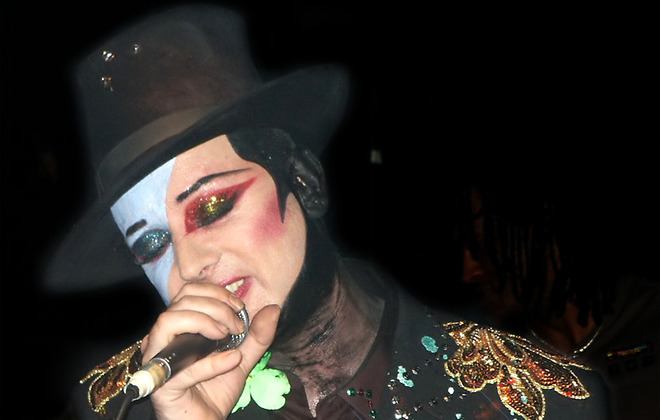
Certainly the next generation’s club kids were watching with interest. The year before, Steve Strange and Rusty Egan had launched Bowie Nights at Billy’s (1), 69 Dean Street in Soho, using exactly the logic of their hero: pose as language, gender as artistic license.
“Billy’s was a kind of seedy place,” remembers Princess Julia, seasoned party-goer, founder of PIX magazine and current East End club idol. “I used to go there before and it was just a tranny club.” After punk, these trashy environs were a cause célèbre, a starting point for creation. Styles were appropriated and exploited by cross-dressers, dandies and Bowie clones. Faces became canvases as make-up was applied like gloss. “There was an element of competition, who can outdo each other with the most ridiculous outfit,” she says. “[Boy] George would borrow clothes. We were all sharing things and just sort of experimenting with sexuality, clothes, image, gender.” As roles blurred, and punk segued into new romanticism, these nights got popular, necessitating a relocation to the larger Blitz on Great Queen Street. Inevitably, Bowie visited his eponymous Night himself, on a recruiting mission for people to appear in his Ashes to Ashes video.
During the ’70s he had gone from hippy to Ziggy to Thin White Duke. The latter role was inspired in part by his hero, the subcultural godfather and queer-lit pin-up William Burroughs, besuited writer of Junky, Queer, and Naked Lunch. Years earlier, Burroughs too visited No 69 when it was still known as Gargoyle, a drinking establishment that had been opened in 1925 by the Hon David Tennant.
Visions of Burroughs in Soho are recalled today almost like apparitions. One sighting, just around the corner from Billy’s, on Frith Street in August 1972, came when he is said to have taken part in a solo “psychic campaign” against the Moka Coffee Bar (4), one that involved the incessant playing of a reel-to-reel tape recorder. Burroughs was apparently unhappy with the “poisonous cheesecake” served to him, as well as the “outrageous and unprovoked discourtesy” of the staff. He stood outside the bar on a daily basis, playing back sound recordings he had made on the reel-to-reel. As his campaign progressed, trade declined. By the end of October “Soho’s first coffee bar” shut its doors. Apparently Burroughs was delighted by the name of its replacement: Queen’s Snack Bar.
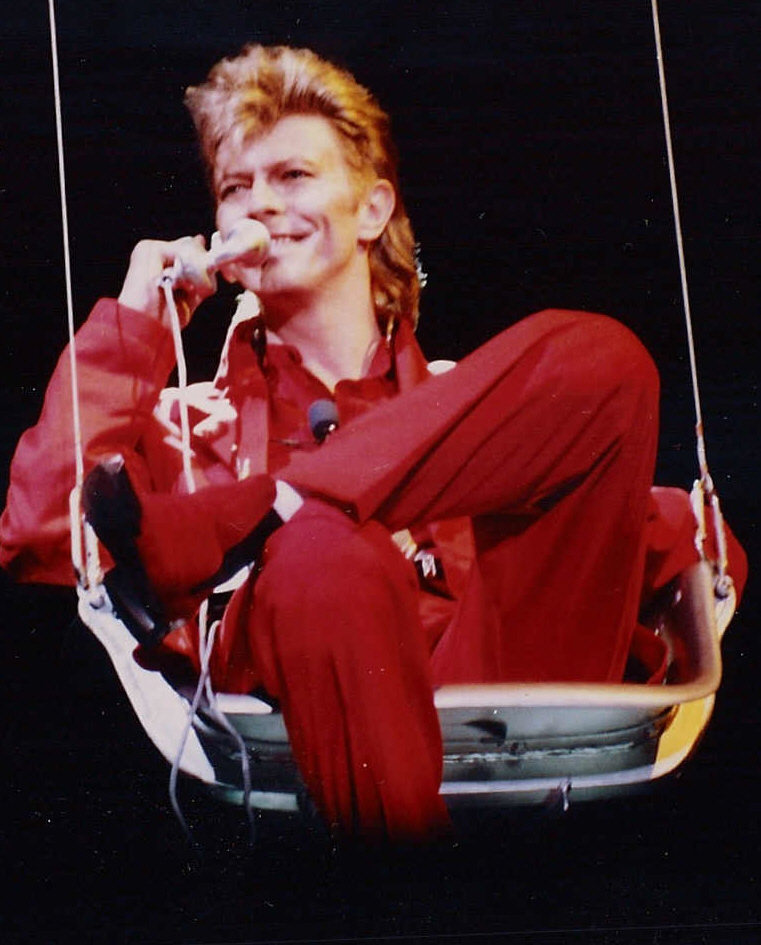
David Bowie 1987
Soho in the ’70s was far from being London’s gay hotspot – that mantle went to Earls Court, where leather queens hung out at clubs such as Sombreros and the Coleherne. Yet Tricky Dicky, who ran Trax Records (2) at 55 Greek Street until it closed in 2008, was responsible for the first gay discos, which appeared across London from the ’60s onwards, in pubs in Euston, Stratford, Bishopsgate and Camberwell. Bang (3), which moved into the basement of Astoria Theatre at 157 Charing Cross Road on Monday nights in 1974, was the first gay club of its size in the area. “It was a whole new world of clubbing,” says the gay rights campaigner and Outrage! founder, Peter Tatchell, who’d previously frequented Tricky Dicky’s discos and Earls Court venues. “It was gobsmacking. There was a lot of shagging in the toilets. But most important was that all of a sudden you could go to a venue with 1,500 other gay men dancing to Tavares disco-soul classic Heaven Must Be Missing an Angel.” The venue retained its significance, hosting Philip Salon’s Mud Club in the ’80s, and more recently G-A-Y, until it was demolished last year to make way for the new Crossrail development.
Bang was fairly safe, but by the mid-’80s there were around 20 on/off illegal gay clubs, such as the underground Pink Panther’s on Wardour Street, which served booze without a licence to a crowd of rent boys and transexuals. In 1985, Leigh Bowery, the artist-cum-art object, who made a habit of sporting prosthetic accessories as part of his “art of going out”, started Taboo (5) at Maximus, 14 Leicester Square, another down-at-heel venue, with club entrepreneur Tony Gordon.
A series of booths circled a sunken dancefloor. DJ Jeffrey Hinton was in charge of Taboo’s music and visuals. “I was heavily influenced by Italo-disco,” he says. “It wasn’t really being played anywhere, but I just loved the naivety of the vocals, sung in second-language English.” Hinton adopted his own cut-up technique, splicing Italo with punk, disco and pop, and layering strange sound effects and videos over it. “Porn, horror, bits and pieces that I’d filmed, really chopped and mashed up. It was very disorientating but in that kind of place it really worked. It reflected the chaos. If you went down there feeling normal, it would mess you up. But most people arrived messed already, so it suited them.”
Indeed, these clubs were like cut-ups of the landscape they inhabited; the interiors’ faded glamour, filled with an explosion of music and fashion, supplemented by the porn of Soho and the decadence of the patrons. As if to underline the point, the preferred dance routine at Taboo’s was rolling around the floor. “That was what most of us used to do, on the floor writhing around,” remembers Hinton. “Leigh enjoyed that because it was really inappropriate – most of us were big fans of anything inappropriate, in fact.”
Taboo fell apart under the strain of too much popularity and too many drugs. Doorman Mark Vaultier and Bowery’s protégé Trojan died of overdoses and the club was closed under police pressure in 1986. In 2002, this enfant terrible of the gay scene inspired a West End musical with Little Britain’s Matt Lucas playing a pantomime Bowery.
Heaven (6) under Charing Cross station’s railway arches on Villiers Street was opened by entrepreneur Jeremy Norman in December 1979. The premises had previously been Global Village, featuring a camp-as-hell roller-disco night, and a gay night, Glades.
Fat Tony, who later set up Playground at the Lyceum and Jungle, London’s first gay house night under the Astoria, remembers a tentative early visit to Global Village. “I went when I was 13, but I never went in: I just stood outside like a freak because I was too scared to go in to the gay club.” By the time Heaven came along, Tony had plucked up the courage to cross the threshold. “When I finally did go in, it was better than any other drug that I ever took in my lifetime,” he says.
The club started as a men-only gay venue, the most proudly ‘out’ of its kind. Full page adverts were printed in magazines and flyers handed out on the streets. “There were no women in there but I used to go,” says Julia “They let the odd one in but it was really gay, quite hardcore.” Hinton DJed at Cha Cha’s, a precursor to Taboo that took place around the back of Heaven. He also speaks of an even more extreme club behind the venue, around the same time as Taboo: “It was actually part of an old sewer system. You had to bang on the metal lid, someone would lift it up and let you in. Smoke and the smell of poppers would rise up as they opened it and you’d literally just go down the ladder into hell.”
Richard Branson bought Heaven from Norman in 1981, enduring pressure from the tabloids disgusted with its overt homosexuality and drug-guzzling. Yet it won a reputation as the greatest gay superclub in the world for its amazing visuals and quality acts, such as Grace Jones and Eartha Kitt.
Today, Jeffrey Hinton is the club’s longestrunning DJ; but he accepts that, with the merger with G-A-Y and takeover by the MAMA group, it has become more commercial and risk-adverse than in its heyday. The scene has moved out to Vauxhall clubs like Fire, but they’re too blandly druggy, too mindlessly sex-driven for him. Heaven’s marketing and promotions manager Chris Selby-Rickards has been at the club for ten years, and runs the popular Monday staple, Popcorn. He admits that Westminster Council have made it harder to keep the club’s edge.
“It took all of our persuasive powers to get a nudity licence,” he says. “Westminster don’t really want nightclubs like ours.” The space was used as a hospital in WWII, and the rear was a morgue where a nurse was supposedly murdered: before that, it was used as a wine cellar for the Charing Cross hotel.
Intrigued by its varied history, Selby- Rickards, a keen seeker of the paranormal, regularly goes on ghost hunts around the building. “They say hauntings are caused by residual energy: being a venue that has had thirty million people through its doors, as well as having been a hospital and the rest of it, makes activity seem inevitable,” he says. “I see things all the time, people walking around who aren’t there. But they are only brief glimpses.”
William Burroughs, the thin-lipped apparition himself, came to Heaven in 1982 to give a reading. Jeffrey Hinton was working that night. “He read from a plinth that was raised high up above everyone on the dancefloor, like a monolith,” he recalls.
The reading was filmed by Derek Jarman, who immortalised the event in his short film Pirate Tape, alongside drone-like noise experiments over which Burroughs’ voice echoes like a Xeroxed spectre.
Peter Tatchell was a regular at the time of Burroughs’ visit. Listening back to my interview tape, as Tatchell starts to speak about Heaven, static interference turns his voice into a similarly nightmarish scratch. It’s wiped out with a sustained block of white noise, which leaves only a single decipherable declaration, one that might provide a fitting epitaph for the place in years to come: “If Bang was Wow!” the voice pierces faintly through the din, “then Heaven was Wow! Wow! Wow!”


 Share on Facebook
 Share on Twitter
 Subscribe
 Comments







Comments