

PIRACY PANACEA
 Share on Facebook
 Share on Twitter
 Subscribe
 Comments
PIRACY PANACEA
09 Monday 09th August 2010
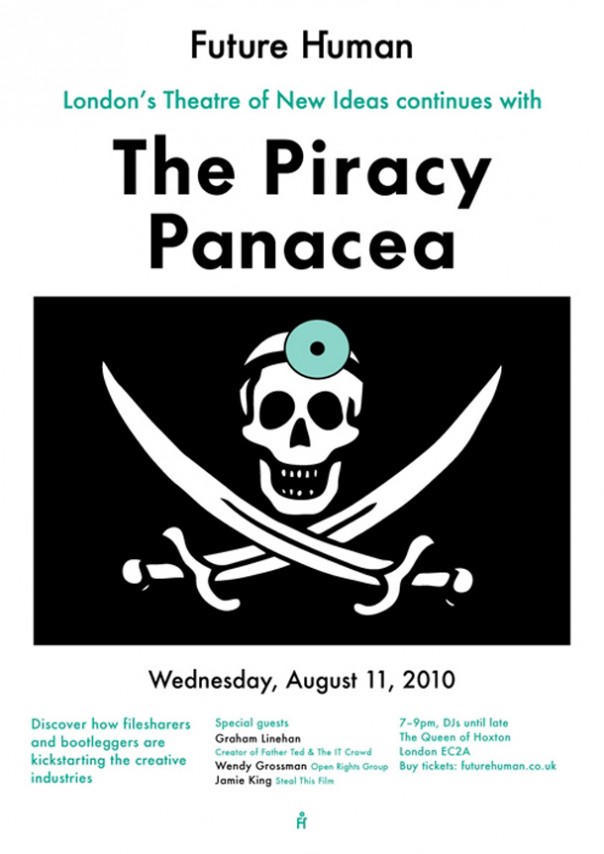
The sixth Future Human event is taking place on 11 August at The Queen of Hoxton in Shoreditch. Piracy Panacea will delve into the undergrowth of internet piracy, wading into the debate about digital file-sharing and the anti-copyright movement. Graham Lineham, creator of Father Ted and The I.T. Crowd, will be amongst the panel.
This talk is set to inject a healthy dose of alternative thinking to the issue of internet piracy. The debate currently runs around in circles, proclaiming the need to tackle internet piracy because of its supposed detrimental impact on the creative industries. Enter the Digital Economy Act. The Internet Service Providers are up in arms about the Act because they don’t want to take up the mantel of internet coppers; and the Jones are in a tizz because they’re worried that little Jimmy’s tinkerings upside on the shared computer is going to get the whole family’s broadband cut.
Considering that it is estimated that six million people in the UK regularly file share copyright content without permission, surely it’s worth questioning whether the proposed methods of tackling internet piracy are going to be most effective. Perhaps we should be questioning what the pirates are bringing to the creative industries, rather than focusing on the assumption that they are destroying them.
Take Digital Rights Management for example. On the whole, pirated creative material is DRM-free. This arguably has its advantages for the consumer as it means they are not locked into one sole digital music provider. Not to mention, you can share your music with your mates. Which gets us into the murky waters of ownership rights and the question of whether it’s “fair” to the artist to produce subsequent copies of their material without paying for it? But maybe it’s not as detrimental to the "struggling artist" as the record labels might have you think. By getting your friends into a band by giving them a copy of an illegally downloaded CD, you are more likely to convince them to buy a ticket and come along and see them live with you than by trying to convince to buy that CD “legitimately". It's no rocket science that ticket revenue (not to mention the merchandise sold at those gigs) is a much bigger money-maker than CD sales. Win-win situation, some might say.
Another case in point is the advent of legitimate file-sharing technologies. An Entertainment Media Research study revealed that 64% of people would pay for a legal download site if it contained the content they were looking for. So presumably services like Spotify and LastFm were surely born out of a need to quench the consumer’s thirst for a more substantial range of music online. It is that naive to think that maybe a big chunk of people illegally file sharing are doing so because they just can’t find that obscure or yet-to-be-released-but-very-hyped-up track or movie through legitimate channels?
So really we should be saluting the internet pirates for keeping the creative industries on their toes. In some ways they are doing a better job of regulating cyberspace than Ofcom. Perhaps these hackers and marauders terrorising the creative industries actually hold the key to their renaissance.
The Piracy Panacea will take a closer look at modern piracy, and give insight into the tremendous innovation and cultural change it is unleashing. From the utopian anarchism of idealists and technologists to post-piracy economies such as China and Brazil, Future Human will give insight into how new illicit technologies will shape the long-term future of British society and commerce.
Don't Panic attempt to credit photographers and content owners wherever possible, however due to the sheer size and nature of the internet this is sometimes impractical or impossible. If you see any images on our site which you believe belong to yourself or another and we have incorrectly used it please let us know at panic@dontpaniconline.com and we will respond asap.
MORE FROM DON'T PANIC

















Comments