

SIMON NORFOLK
 Share on Facebook
 Share on Twitter
 Subscribe
 Comments
SIMON NORFOLK
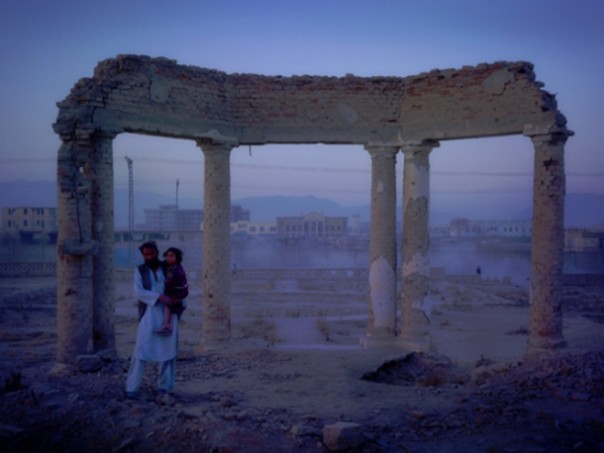
Simon Norfolk has been taking pictures for over 20 years; he’s travelled the world, been shot at and was possibly at the centre of a kidnap plot too. Pretty dramatic for someone whose first job was snapping a woman in a sandwich shop in Bristol. Norfolk’s previous projects have explored genocide, war crimes and the aftermath of war. His current exhibition at Tate Modern, Burke + Norfolk: Photographs from the War in Afghanistan is a series of photographs that sees Norfolk return to the war-ravaged country (he was there for his 2001 project, Afghanistan: chronotopia) and use nineteenth-century photographer John Burke, the first to photograph Afghanistan, as a cue and collaborator. We met up with Norfolk at the Tate to talk about his experiences photographing there and his disappointment over this ten year war.

How did you use John Burke’s photographs to initiate your own work for this exhibition?
Even people who know Victorian photography quite well haven’t heard of John Burke. There are two albums of his Afghanistan photos in the exhibition and I think there are only 14 in the world. So for me re-exposing his work is like as rare as finding a Neolithic bone fragment or a piece of Egyptian hieroglyphics and saying ‘look, you’ve never seen this’.
I call it an artistic partnership between me and Burke really, the only difference is he’s dead, but in every other aspect it’s a partnership. I copied a lot of his motifs. If I did a portrait everyone would stand and look at the camera. What’s fantastic about Burke is that he completely breaks that up, the gaze is left, right, down, up, forward, it’s really interesting. It never would have occurred to me.
I spent my first week there walking to the places where he took his pictures, I used the terrain feature in Google Earth to work out exactly what mountains he’s looking at from the ridgelines, using his pictures and Google Earth, and then reading backwards on a line so you could work out which hill he’s standing on. After that it became ‘variations on a theme by John Burke’, to think ‘what would he photograph if he were there now?’ because he had such an inquisitive eye. So it was more kind of using him as a guide book, like Lonely Planet Kabul 1880 edition (laughs).

How was it photographing Afghanistan compared to when you were there in 2001?
In 2001 I thought the war was over, I thought Afghanistan would pick themselves up and build a new society. Back then I would get up at 4am to take photographs with this golden light, to show this end to a great era/the dawn of a new beginning. This time, I was photographing my disappointment, my bitterness that my government has pissed away ten years of treasure and blood and nothing has been achieved. So this time I photographed the pictures in a very soft, blue light because I felt that was best way to get across my sense of tragedy about what’s happened to this poor, fucking country.
Would you ever class yourself as a ‘war photographer’ or rather one that captures the effects of war?
It depends who I’m talking to. If I’m trying to annoy the artsy crowd in here, then yeah I’d call myself a war photographer because they’re completely outraged that war photography should be shown in their la-di-da gallery. I think the greatest achievement here is not me getting my name out there, it’s getting the words ‘The War in Afghanistan’ on the outside of this building, which for me is fucking fantastic.

So it’s a conscious decision leaving out the more obvious/graphic aspects of war, you focus on the environment.
Yeah I think there are four or five traditional types of picture which get repeated; man shooting in a ditch, wounded kiddy in a hospital, soldiers messing around in their barracks etc. I think they’ve really failed to tell us anything about what this war is about and they’ve contributed to our boredom about it. I wouldn’t say this country was pro-war or anti-war, rather this country doesn’t really give a shit about it. Unless you’ve got a member of family there or something, you’d barely know the fucking war was even going on and this is ten years.
What’s the furthest you’d go for a photograph in terms of risk factor, is there anything that would stop you?
I had some fantastic help in Afghanistan by a photographer named Fardin Waezdi, he’d give me great security advice, I’d say ‘Fardin what do you think about driving to Jalalabad?’ and he’d say ‘75% chance of survival’, it was very simple to understand. So it’s not about being afraid to do anything because of risk, it’s about how to work around these problems. Kabul is a very dangerous city, but it’s also a city where 4.5 million people live their lives, bring up their kids and do their jobs.

Did any of the soldiers try and stop you from taking photographs? Did your opinions ever differ about the war when you were with them?
Kind of. The British don’t vet you so hard, like the Americans, but they watch you like a hawk when you’re there and they have to see everything that you shoot. So either way there’s some censorship.
There’s this system called the embedding of photographers, which is this new way of dealing with them since the Iraq war. They place photographers with very small platoons/squads which bulldozes all of your resistance and politics to the war because you’re living with these boys in a tent. They’re nice to you, they’re saving your life or cooking you dinner, so you become thankful to them for your personal survival in scary places. The embedding system has succeeded in completely crushing any dissent by photographers. Photographers/journalists are rolling over to have their tummies tickled and the military know that. When I was in the bases I just wanted to photograph their sewage plants but they really wanted me to go and photograph the ‘bang bang’ and be with the soldiers because they knew that as soon as you get in a trench with these guys, you start to feel the same things as them. But I don’t feel like there’s an ‘us’.
So do you think there’s a difference between what we see in the media, to what you’ve seen yourself?
Yeah I think it’s extraordinary. I took all those pictures in Kabul, of the way Kabul has changed and I showed those pictures to the picture editor of the New York Times Magazine and she sees everything because she works for the best magazine in the world. And she phoned me up saying ‘my god, I never knew it looked like this’ and I was almost angry about that, why don’t you know it looks like this? There must be 400 photographers in Kabul at any moment in time, so what the fuck are they photographing if they’re not photographing Kabul?

What are your opinions on modern photojournalism?
It’s sad, but photojournalism is still the same, in that it’s not just the same as it was in 1990 when I started as a photojournalist, but it’s pretty much the same as it was in 1940 when Robert Capa invented the mode in the Spanish Civil War. The technology of war has risen enormously, so the pictures that we’re seeing coming out of Afghanistan are of soldiers shooting rifles, whereas the actual warfare that’s being performed is predator drones at 40,000ft firing Hellfire missiles at countries that we’re not even at war with, where are those pictures? Where are the photographs of Special Forces shooting Osama Bin Laden? There aren’t any. The warfare isn’t being portrayed at all, because we’re stuck with the fucking cliché of men running across fields shooting at things and it’s really not how warfare is fought nowadays. We’re in the middle of a war with Iran and it involves America and Israel using computer viruses to destroy Iranian factories, how do you photograph that?! I don’t know, but I wish some photographers were pouring out of colleges with great ideas about how you do, do that because that’s the important stuff. I don’t think we’d call it photojournalism though when it comes along, we’ll call it something else.
You’ve focused on genocide and other war crimes within your work, what’s the drive behind this?
Turn the question on its head. Why the fuck isn’t everyone else doing it? This is what our world is made of, what am I supposed to make work about, how gorgeous my girlfriend’s bottom is, flowers, trees? What the fuck is that? We’re at war. We’re paying for this, your brother is fighting there, the reputation of our country. And on top of that we’re no safer now than we were ten years ago. What is art for? I thought it was to draw a picture of our age. People are ignoring the most obvious thing that we should be doing.

So what’s next for you after this?
After this? Lecturing students (laughs). I don’t want to do any more kind of rubble that’s for sure; it’s a bit hard on the soul. I’m still interested in conflict, but I’m interested in things like, how is conflict made possible? For example by a military industrial complex. You know these weapons manufacturers who’ve made millions out of the war in Afghanistan and have used Afghanistan as a kind of outdoor laboratory for testing a new weapons system so I want to see if I can get into the manufacturing side. Recently I was in a factory where they make typhoon fighter jets and it was extraordinary, so I think I’d like to try and do that but it’s very difficult.
Lastly, is there anything that you wish you’d have been able to photograph in the past?
The one thing I would’ve really wished I’d been present at was the nuclear weapons testing in the Pacific in the 60s. I think that sums up all my ideas about god in a godless world, fear, the fear of something limitlessly powerful. I would’ve liked to have seen that.
Simon Norfolk's exhibition Burke + Norfolk: Photographs from the War in Afghanistan is at Tate Modern now until 10 July, for more details click here. And you can see Norfolk's official website here.
Don't Panic attempt to credit photographers and content owners wherever possible, however due to the sheer size and nature of the internet this is sometimes impractical or impossible. If you see any images on our site which you believe belong to yourself or another and we have incorrectly used it please let us know at panic@dontpaniconline.com and we will respond asap.
MORE FROM DON'T PANIC






Comments